

Summary
If your hardware ever sees vacuum, low pressure, sealed optics, or ultra‑clean environments, ASTM E595 is already shaping your material and process choices—even if no one has said the words out loud.
In the 1970s, NASA created what would become ASTM E595 to address a very specific problem: molecular contamination on spacecraft. When polymers, cables, adhesives, and lubricants outgas in vacuum, the volatiles condense on cold, sensitive surfaces—such as optics, thermal control coatings, and sensors—and quietly degrade performance. The industry needed a way to screen and qualify materials before they ever flew.
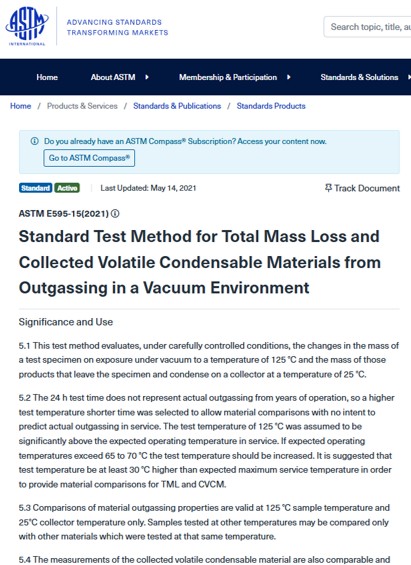
ASTM E-595 Outgassing Test Standard
ASTM E595 is that screen.
It measures two simple but unforgiving numbers under high vacuum at elevated temperature:
- Total Mass Loss (TML): How much mass a material loses when it’s heated in a vacuum.
- Collected Volatile Condensable Materials (CVCM): The fraction of TML that condenses onto a cold collection plate.
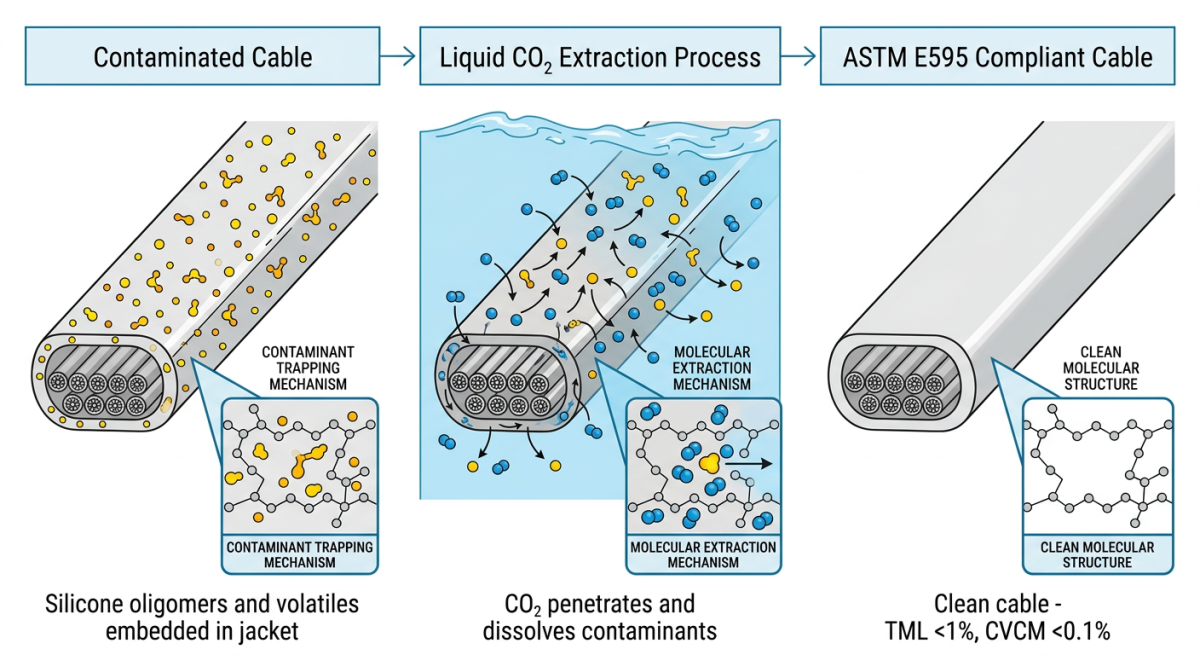
For most spaceflight programs, the acceptance criteria are as follows:
- TML ≤ 1.0%
- CVCM ≤ 0.10%
On paper, this sounds like a niche space‑only requirement. In reality, it is a global de facto standard for materials used in any environment where outgassing contamination can’t be tolerated.
From Apollo and Skylab to… Everything
ASTM E595 evolved from NASA’s original “Test 7” work during Apollo and Skylab, when engineers watched condensable vapors fog lenses, change thermal balance, and contaminate life‑support atmospheres. Those early lessons still apply—but the applications have greatly expanded.
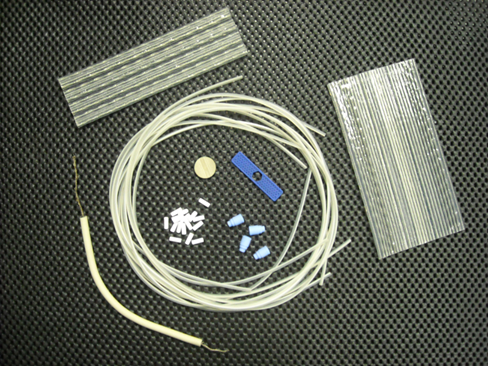
Many Different Products and Applications Require Outgas Cleaning
Today, E595‑equivalent requirements show up in:
- Spacecraft and satellites
- Military and defense avionics
- Semiconductor process equipment
- Precision optics and photonics
- Medical devices and analytical instruments
- Cleanroom tools and high‑purity manufacturing
- High‑ and ultra‑high vacuum research systems
Anywhere a volatile film on the wrong surface can cause a mission failure, yield loss, or safety event, outgassing is on the risk register—whether it’s called “ASTM E595” by name or not.
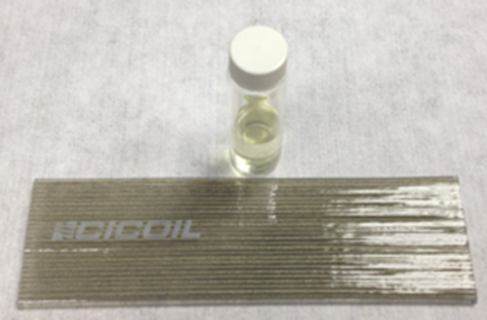
Silicone Insulated Electronic Cables and Outgas Contamination
Why Outgassing Is So Damaging
Outgassing isn’t just an abstract material property; it has very specific, very expensive consequences.
A few examples:
- In spacecraft, condensable vapors fog lenses, mirrors, and solar panels. Thin films on thermal control surfaces change emissivity and absorptivity, altering thermal models and margins.
- In military avionics, outgassed residues can create conductive tracks, trigger intermittent faults, or degrade sensor performance inside sealed bays and pods.
- In semiconductor tools, molecular contamination from plastics, seals, cable jackets, and adhesives forms deposits inside process chambers. That translates directly into particle adders, yield loss, and unplanned downtime for cleaning.
- In precision optics, even nanometer‑scale films on lenses, mirrors, or coatings reduce transmission, change reflectance, increase scatter, and destabilize high‑power laser systems.
- In medical and analytical equipment, residual volatiles can compromise biocompatibility, contaminate sterilization environments, or interfere with ultra‑sensitive mass spectrometry and chromatography measurements.
- In cleanrooms, outgassing contributes to molecular film formation and particle generation that can push tools or entire areas out of class.
One uncomfortable truth: even “low‑outgassing” materials can fail E595 if they’re dirty. Machining oils, mold release agents, flux residues, handling films, and absorbed solvents all show up in TML and CVCM. A material that looks great in the NASA database can still fail in your application if cleaning and preparation processes aren’t up to the job.
The Business Side: Why This Matters Beyond Engineering
For engineering leaders, E595 compliance is about reliability and performance. For operations and business leaders, it is also about:
- Risk: One contaminated optic or sensor in orbit is not field‑serviceable. The cost of a failure dwarfs the cost of doing cleanliness right.
- Yield: In semiconductors and precision manufacturing, even modest contamination‑induced scrap or rework can explode the cost of goods.
- Reputation: OEMs in space, defense, medical, and semiconductor markets live or die on reliability records. A contamination‑related failure is a reputational event, not just a quality issue.
- Regulatory and contractual requirements: Many primes, agencies, and tier‑one customers now embed E595‑style outgassing requirements in specs, statements of work, and quality clauses.
This is why ASTM E595 has quietly moved from “spaceflight specialty test” to “baseline cleanliness expectation” across multiple high‑value industries.
Where This Series Is Going
This first installment sets the stage: ASTM E595 isn’t just a test; it’s a cross‑industry cleanliness standard that’s reshaping how we think about materials, processes, and risk.
In the next parts of this series, I’ll cover:
- Why traditional solvent precision cleaning is increasingly incompatible with E595‑level performance and modern EHS requirements
- How thermal vacuum bakeout solves one problem but creates others—material damage, aging, discoloration, and long cycle times
- How liquid CO₂ extraction works, and why it can achieve E595 compliance without the environmental or material penalties
- Real‑world case data (including silicone‑jacketed aerospace cables) and an implementation playbook for operations and quality leaders
If you’re responsible for hardware that lives in vacuum, sealed optics, cleanrooms, or high‑reliability environments, this isn’t an abstract standards conversation—it’s about product failure rate, margins, and reputation.
If you’d like to discuss applying this to your specific hardware (space, defense, semiconductors, medical, or optics), feel free to message me on LinkedIn.
